Sunday, 12 June 2022

Bosteels Pauwel Kwak

Origin: Belgium | Date: 2017 | ABV: 8.4% | On The Beer Nut: May 2007

We were transiting through Brussels airport, Dr John and I. At the emporium of boozy delights he acquired a Kwak giftpack for a friend who, he assured me, was only interested in the glass. So the beer was spare and he gave me two of them. One was cheekily necked in the departures area, but I saved the other for future use on my vintage beer blog. That was five years ago, which I deem long enough to find out if Kwak changes any over time. As a strong and dark Belgian ale, it feels like it should, though it doesn't get the vintage treatment in the same way the Trappists do.

It probably doesn't help things that I haven't had any Kwak since that evening in the airport but I have a reasonably strong impression of how it tastes: a big and heavy sweet-banana driven ale, especially high in esters, even for Belgium.

After five years, the first thing I notice is that the lees have settled in big lumps to the bottom of the bottle, suggesting it's been busy in there and should therefore be somewhat protected from oxidation. The aroma is muddy and bready, smelling like kvass, more than anything. Certainly not sweet. And the flavour has dried out considerably, dropping the banoffee in favour of raisins, nuts and dark sherry, with a backing of strong tea and a little toffee liqueur.

I think it's an improvement on fresh, and isn't a million miles from what happens to Orval over a similar timeframe. I never would have thought of ageing Kwak had I not acquired a spare bottle by sheer happenstance, but I'm glad I did.

Friday, 25 February 2022

Porterhouse Celebration Stout

Origin: Ireland | Date: 2006 | ABV: 10% | On The Beer Nut: October 2006

It's been another five years since this guy last appeared on this blog. I wanted to see how Ireland's seemingly indestructible first imperial stout of the craft era was getting on.

The brewery's branding has moved along so the glass is different but the beer still looked the same: a cola brownish black with a thin skim of beige foam on top. The aroma still has a slightly phenolic hit of TCP and marker pens, something I noted last time out so I'm not especially worried about it here.

With several more years of imperial stouts under my belt, what impresses me most is how dry it is: burnt toast and dry grass; not how anyone makes this sort of thing now. Secondly it's still pretty much totally devoid of off-flavours, with no more than a hint of sherry oxidation. That's kind of it, though. Looking back on my 2016 review I was awestruck by the complexity. This doesn't have that. It hasn't gone bad, but I think its peak may have passed. We've been left with a pint of earthy bogwater which is clean, but by no means a supreme imperial stout. Sic transit, etc.

I have a couple of bottles left, and with luck I'll get to them in due course, but I think this one's place as a special-occasion celebration beer is now lost, unless something else changes in it next.

Sunday, 20 February 2022

YellowBelly Mashtun Millionaires

Origin: Ireland | Date: 2021 | ABV: 7.4% | On The Beer Nut: March 2021

It's about a year since I drank Mashtun Millionaires, one of a pair of beers which represented the final new releases from YellowBelly brewery, though we didn't know it at the time. The brewery had been doing everything right in terms of having a reliable core range, geek-pitched one-offs, two tied pubs and an overall plethora of good will. I guess it just wasn't enough. There's talk of a revival and I hope it works out.

Meanwhile, in Molloy's off licence recently, I spotted two bottles of Mashtun Millionaire in the expiring beer discount zone. First off, it's dated June 2022 so should be fine; secondly it's a strong Brett-fermented ale in an armoured Belgian bottle so should be absolutely fine; and thirdly it was priced at €2.50 a bottle so I bought both of the ones displayed. As it happened I had stashed a bottle that I acquired from the brewery last year for €6, so what better excuse to get it open?

Brett perfume is the first impression, mostly lavender and violet, with a greasy but enticing rotten funk in the background. The flavour takes that fermenting-flowers sweetness and adds in an incense spicing with some oaky vanilla. While all funky and farmyard to begin, the finish is pure and clean, with crisp white lemonade and sparkling dry cava.

In my original assessment I found it dirty and tough going to drink. I'm confident now that it has cleaned itself up and begun to fulfil its potential. I suspect it still has a way to go so don't crack your spare bottle just yet. Me, I'm very glad I have two more still in the stash.

Thursday, 6 January 2022

Fuller's Vintage Ale

 Origin: UK | Date: 2015 | ABV: 8.5% | On The Beer Nut: August 2008

We have added a best before date of December 2025 as this exceptional ale will improve for many years to come, like a fine wine or whisky.

So wrote Mr Keeling on the box, and I can't help feeling I'm being a bit premature in opening this, but I reckon six or so years is plenty to take stock (no nerdy pun intended) of what this beer has become. I'm not sure Fuller's Vintage has been available in these parts for some time now so I can't compare with a fresh one, and it's been over a decade since I last tasted it so don't ask me what it's originally like.

This one is a handsome amber shade, with surprisingly decent off-white head retention. It smells of caramel and raisins, which is probably not far off the original. There are certainly no early signs of agedness. And few in the flavour, too. It's rich and fudge-like, with a slightly harder toffee edge and a smidge of buttery shortbread: a raid on the tartan tins in the Scottish giftshop of your choice.

A faint vinousness suggests port or sherry, indicating that this is still in the early phases of transformation. Oxygen-influenced, but not oxidised. I reckon there are a few years left in it yet. And, as befits a beer purposefully built for ageing, I detect a distinct robustness about it, an open challenge to the ravages of time to do their worst. I think this will get better, exceedingly enjoyable and all that it is now. Seems Mr Keeling was right all along.

Sunday, 19 December 2021

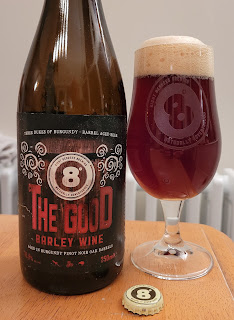
Eight Degrees The Good

Origin: Ireland | Date: 2017 | ABV: 10.9% | On The Beer Nut: June 2017

This beer was originally intended as part of the Christmas 2016 range from Eight Degrees but ended up delayed until the following spring. Even then, I thought at the time that it would benefit from some cellaring to smooth out its sharp edges, and the heavy hops in particular. It's time to check in again, and I have no memory of how it tasted, so am more interested in whether it's good than whether it's improved. 

It's good. There are still vestiges of its former self in there, though the harsh bitter kick has been replaced by a dry tannic quality. Before that there's a big jammy malt buzz, like moist fruitcake and ruby port. Raisin, glacé cherry and high-cocoa chocolate all feature. It's a fun mix of dry and sweet, with a lasting aftertaste of red vermouth.

I don't get any sense of this being an aged beer: no oxidation or autolysis, though only a little extra bonus smoothness. While it has definitely changed, I can't say whether it has peaked or not, but I do have another bottle so perhaps we'll find out in another few years.

Sunday, 28 November 2021

Eight Degrees Devil's Ladder

Origin: Ireland | Date: 2020 | ABV: 11.5% | On The Beer Nut: December 2020

I do like it when someone else does the cellaring for me. Eight Degrees sent their annual seasonal gift package during the week (thanks folks!) and along with the recent releases it included one from a year ago. The base of the can tells me that this was packaged on 3rd December 2020 and therefore is best before 3rd December 2022. Throw it out to the beer bloggers, sure. They'll drink anything.

I wasn't expecting a canned tripel (aged in sherry casks) to have changed much in a year, especially since the brewery was most likely storing it correctly through the summer. I said it was clean and crisp and boozy, originally, with notes of mead and dessert wine. And I think it has changed a bit, reverting to something that tastes much more like a typical tripel. The sherry is still there in the aroma but it doesn't make much of a contribution to the flavour. I get banana esters primarily, and then honey (not mead), clove and cinnamon. As it warms, a growing toffee backbone emerges.

The difference with the fresh version, or at least my notes on it, was surprising. I guess the general rule that pale beers aren't enhanced as well with time as dark ones holds true for tripels also. This seems to have lost some of its delicate complexity. It's still perfectly serviceable, however, so enjoy it if you have one, but maybe don't sit on it too much longer.

Sunday, 3 October 2021

Cantillon Gueuze

Origin: Belgium | Dates: 2016 & 2021 | ABV: 5.5% | On The Beer Nut: October 2007

Not all beers improve with age. The strong and dark ones get the best press, which is fair enough, but vintage gueze is also revered. It's a phenomenon about which I am sceptical. I like the clean zest of young gueze and am not at all convinced that letting it age out is necessarily a good idea. Luckily, I have this blog for the testing of opinions like this and today I'm tasting the difference blind.

The field of play is two bottles of Cantillon Gueuze, one bottled in March 2016 and one bottled five years and two days later. The cork of the vintage one was saturated in beer but hadn't turned mouldy, as sometimes happens. Feature one of age is fizz, with the older edition much more foamy on pouring. With that comes sediment: the one that turned out to be the 2016 was much cloudier than the 2021, which was a bright amber-gold.

I was on the lookout for that zest effect, and the 2021 had lots of it in its aroma, all fresh and zingy lemon spritz. The older one smells funkier, with a more pronounced earthy aroma, hinting a little at blue cheese. Both are excellent but, as mentioned, my taste runs more to the zest.

The difference between them is not as apparent on tasting. The 2016 is smooth with notes of old oak and a waxy bitterness. The gunpowder and black pepper spicing arrives late. I found the younger version to be sharper, with an almost vinegar tang in the foretaste. The zest is present but not as prominent as I noticed in the aroma. It's still very very good, but less complex than the matured one, and complexity beats zest, for me. The spices in particular are missing and I wonder if that's something that comes with the sediment build-up. Even down in the dregs of the 2021 bottle there was a tasty nitric sharpness but not much spice.

I have learned a lesson here: geuze is very much worth ageing. I'm sure there's an upper limit on that -- the brewery suggests 20 years. I'll see how far I get with my last bottle of 2016.