Tuesday, 29 March 2016

Rochefort 8 & 10

Origin: Belgium | Date: 2011 | ABVs: 9.2% & 11.3% | On The Beer Nut: October 2007

My first foray into the Rochefort section of the stash brings a pair of five-year-olds: numbers 8 and 10 in the series. It's a long time since I've had either of these but once upon a time Rochefort was my top pick of all the trappists, especially the 8.

And it's with the 8 I'm starting. The yeast is quite firmly stuck to the bottom of the bottle so I get a perfectly clear deep brown glassful. The aroma is surprisingly subtle, but a lungful pulls out boozy plums and a coarser nuttiness. Although it fizzed as it poured and formed a short-lived head, the surface is mill-pond still after a moment and the first sip reveals it as remarkably flat. Coupled with the dense texture, this produces the sensation of drinking a red wine to begin with, aided by dark plummy fruit. But, after a moment, it miraculously transforms back into beer and there's a wheaty, cakey Christmas pudding flavour and a coating of milk chocolate. The plums and black grapes which add panache to the malt weight taste incredibly fresh, almost juicy. The beer certainly hasn't been ruined by five years of neglect but I don't think it's been enhanced in any way. You may as well drink your Rochefort 8 fresh: no point in taking a risk with it.

With my face already aglow from that, I turned to the even stronger Rochefort 10. It's darker than the foregoing, though no keener to keep a head. The aroma is very enticing: the pure richness of ripe figs and hot fudge sauce. Its super high density is enough to almost make it difficult to sip, but I persevered, feeling every mouthful slip all the way down and form a warming boozy bolus in the pit of my stomach. For flavour, that cakey effect is there again, as are the dark fruits, though the black grapes have definitely turned to dry, chewy raisins. But above them both is a chocolate seam much more pronounced than in the 8, all sweet and quite syrupy. But not sickly, and not hot, bizarrely. This has a lot of the features of very strong beers that makes them difficult drinking, but I think time has rounded them out so the bugs become features: the problems of high alcohol heat have been smoothed away leaving only the benefits. The brewery managed by men of God has turned out a beer that tastes naughty: something about the alchemy of that intense sweet richness, yet lacking in headachey booze, makes me want to do penance for it. Perhaps the five year wait was suffering enough.

Effects of long-term stashing aside, this pair has reminded me that Rochefort beers are of immense quality. When you have the time, the disposition, and maybe a nice piece of cheese, they're always worth it.

Sunday, 28 February 2016

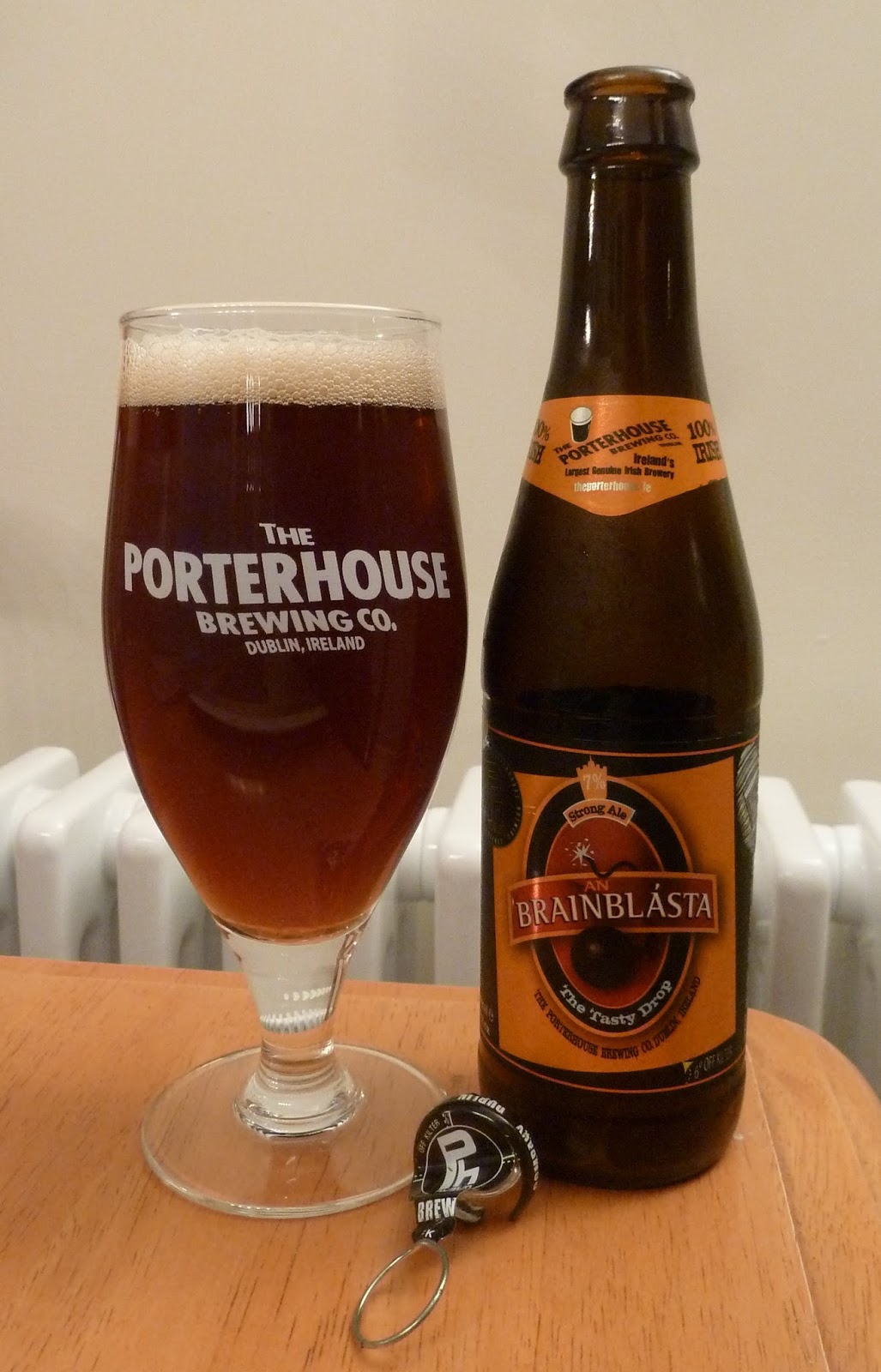
An Brainblásta

Origin: Ireland | Date: 2012 | ABV: 7% | On The Beer Nut: February 2008

The Porterhouse has been brewing this English-style strong ale since its inception in 1996. For years its only noteworthy feature was the strength: pints at 7% ABV are still a rarity even now, but the flavour elicited few comments. Served cold from the keg it doesn't have a whole lot going on, dominated by a severe bitterness and its own malt base. And then in 2009 the brewery launched a bottled range which included Brainblásta. Cellar temperature was a massive improvement and with a few months of ageing it mellowed significantly. I've come to regard mature Brainblásta as one of Ireland's most underrated beers.

So, how far can we take this? This bottle is best-before dated June 2013 and I'm guessing it's been sitting in the stash for close to four years. There's a very vinous aroma, warming with a somewhat concerning hint of sherry about it. And that's there in the flavour too, though only a whisper at the back and I would not say that this is suffering from bad oxidation. At the front, the sweet malt smoothness has a kind of chocolate character, yet it's also quite dry: surprisingly thinly textured and with a green vegetal edge from the remaining hops.

There's a lot more happening in this than you'd find in a younger bottle. It seems busier and less integrated. It's probably a better beer after only one year, but after four it's certainly interesting.

Friday, 12 February 2016

Brooklyn Black Chocolate Stout

Origin: USA | Date: 2009 | ABV: 10% | On The Beer Nut: September 2008

This got less than 20 words on my blog when I first encountered it, sipping a teeny tasting glass at the 2008 European Beer Festival in Copenhagen. It went on to become a firm favourite over the years, after it became regularly available in Ireland. For a while, I think, it had the big American imperial stout sector to itself. And yet I can't remember the last time I drank it, and that's not because of the double-digit ABV. But it's a classic, I've always enjoyed it: how does it hold up after seven years at the back of my attic?

Like a hackneyed movie drunk I had to double-check the label as I poured: it smells powerfully like port wine as it comes out of the bottle. More considered sniffing provides dense dark chocolate liqueur and a not unattractive meaty autolytic note. I remember it as being pretty hop-forward when fresh, but that's all gone on tasting, with not even a residual bitterness left behind. This is chocolate all the way round, sweet and smooth as you like. There's maybe a burr of leathery oxidation in the finish, but it's barely noticeable, accompanied as it is by a distracting waft of winey booze up the back of one's hooter.

I'm surprised to find that the aroma is this beer's best feature, but what an aroma! And even the flavour has developed a classy aged character. If you can keep your mitts off your stash of Black Chocolate long enough, it's rewarding.

Sunday, 10 January 2016

Alpha Dawg

Origin: Ireland | Date: 2012 | ABV: 5.9% | On The Beer Nut: April 2012

You don't age hoppy beers: everyone knows that. Which is why I've moved this IPA to the front of the Stash Killer! queue. I'm just not brave enough to leave it any longer.

It was never a particularly bright and zippy sort of IPA, going more for a serious orangey English thing. First time around I noted that the "sharp resinous bitterness" was the main feature, and it was my understanding that when hop-forward beers mature, the hop flavours and aromas die off but the bitterness remains. But this one has managed to lose its bitterness too. What I'm tasting here, almost four years on, is almost all malt: a powdery Ovaltine malt sweetness. What bitterness there is isn't really hop-related, it's more a kind of metallic aspirin tang with maybe the ghost of those jaffa oranges hovering in the background.

The lesson here is that it's true: lighter hoppy beers don't seem to age as well as the strong and dark. I wasn't a massive fan of this on its first appearance, but time has not been kind to it. Don't let your hops grow old.

Sunday, 6 December 2015

Samichlaus

Origin: Austria | Date: 2008 | ABV: 14% | On The Beer Nut: August 2006

Ho Ho Ho! It's Samichlaus Day, the feast of St Nicholas, the day when Schloss Eggenberg brews its annual strong Christmas beer, before ageing it for ten months. The recipe was inherited from Hürlimann in Zürich, now nothing more than Carlsberg's outpost in Switzerland. Eggenberg is pretty good at strong lagers and has preserved the basic specs of Samichlaus as a 14% ABV doppelbock. My bottle is badged as being bottled in 2008 and the brewery set June 2014 as the expiry date.

It's as dark a red as you'd expect a doppelbock to be. There's a distinctly festive aroma, all cookies and spiced fruitcake. And booze. Lots of booze. I was expecting a blast of heat on the first sip but it didn't arrive. It's surprisingly clean, though definitely thick, packed full of treacle and chocolate sauce: powerfully sweet with a slightly metallic tang and almost chewably heavy. A dry wheaty cereal element finishes it off and there's a classy tawny port vinousness too.

It shouldn't work, but it does. It doesn't get cloying, it doesn't linger too long on the palate and it doesn't congeal in the stomach the way some strong sweet beers do. Most amazing, though, is that there are no age related off flavours. Having peeled off a cap that looks like it's been through a war, I expected at least a bit of oxidation, but there's none whatsoever. I guess the people at Eggenberg are as good at packaging as they are at brewing strong beer.

I last drank this too long ago to be able to tell you if it has improved with age, but it's grand now and I suspect will continue to be grand for many Christmases to come.

Sunday, 29 November 2015

Porterhouse Celebration Stout

Origin: Ireland | Date: 2010 | ABV: 7% | On The Beer Nut: April 2010

This won't be the last time Porterhouse Celebration Stout appears on this blog: I have a few of them. It often shows up on multibuy offers, which lends it to drinking a few immediately and putting a spare bottle or two away. There's also a barrel-aged version and I think I still have a bottle of the original 2006 10th anniversary version around somewhere. But this is an early iteration of the recipe that made it into the core range, bearing the green livery of the Porterhouse's first ringpull caps. The best before is 12th April 2011 so I'm reasonably confident it's from the first run.

I get a distinct waft of savoury umami in with the coffee on the aroma: a dash of soy sauce in your espresso. It tastes very strange and I think oxidation is the culprit. But before that there's a warm and mellow coffee sweetness, much more than I recall in the fresh version, and then that autolytic soy sauce thing which is definitely more character than character flaw, leaning as it does towards cherry liqueur chocolates. It's the finish where it gets weird: a hard, acidic edge which could just be big hops shorn of their lighter nuances, but with a dusty parchment dryness that leads me to theorise that oxygen was at work. My suspicion that those caps just aren't as suitable for long-term storage as crown corks adds to the hypothesis.

A strange drinking experience and by no means a wholly unpleasant one, but I think you may be seeing more Porterhouse beers on here sooner rather than later.

Sunday, 22 November 2015

Orval

Origin: Belgium | Date: 2011 | ABV: 6.2% | On The Beer Nut: October 2007

I used to have a job that paid in Orval. I accumulated a couple of cases and I haven't even finished the first one yet. So I thought it might be interesting to throw a bottle from that stash-within-the-stash into the mix every now and then. 2nd September 2011 is the bottling date, with a best-before five years later, so this is still inside the timeframe envisaged by the brewers for the beer to be as they intended.

It's lost none of its gushing power in the years I've had it: lots of foam generated the mess lacing on the inside of my glass. It's brighter than I was expecting, the yeast mostly stuck fast to the bottom of the bottle.

No horses on the nose, that's for sure. It smells sweeter, all sultanas and similar dried fruit, with a pronounced pithy zest. There's still quite a fresh bitterness in the flavour, the orangey Styrian Goldings still making their presence felt. And I get some hot higher alcohols too: some marker pens and nail varnish remover. Thankfully it finishes abruptly and cleanly so this isn't as much of a flaw as might be imagined.

The overall vibe is warming and cuddly; a slice of fruitcake and a hot cup of tea. Based on recent experiences of drinking vintage Belgian beers brewed with brettanomyces, I expect this one will dry out and get funkier in time. But for now, it's doing a great job.